Velan Veriyattam
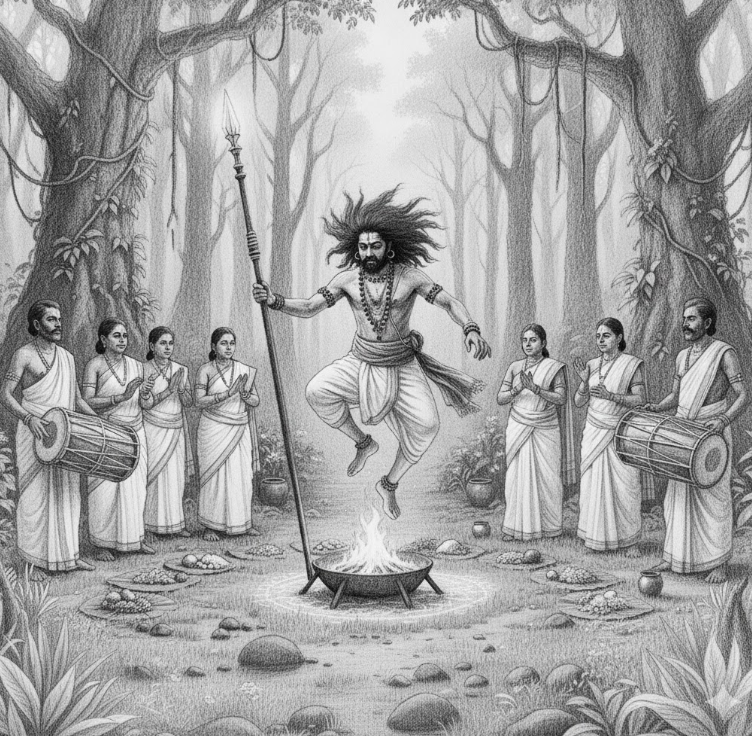
Ancient Tamil literature contains a notable reference to ‘Velan Veriyatal’ in the Tolkappiyam, the earliest extant Tamil grammatical treatise. Although Silapathikaram alludes to temples and religious customs, explicit and elaborate mentions of ‘Velan Veriyattam’ are more distinctly found within the broader Sangam literary tradition, to which Tolkappiyam belongs.
Tolkappiyam and “Velan Veriyattam”
Tolkappiyam offers a foundational insight into the social and religious customs of ancient Tamil society, notably emphasizing the worship of Murugan also known as Seyyon the presiding deity of the mountainous Kurinji landscape. The text refers to him as ‘Sevvel’, underscoring his intrinsic association with the Kurinji thinai.
‘Velan Veriyatal’ refers to a ritualistic trance dance performed by a priest known as a ‘Velan’, a devotee of the deity Murugan. The title ‘Velan’ is etymologically linked to ‘vel’, the spear that symbolizes Murugan’s divine power. This frenzied performance, known as ‘Veriyattam’, traditionally serves as a spiritual diagnostic and healing rite, believed to identify and alleviate states of divine possession.
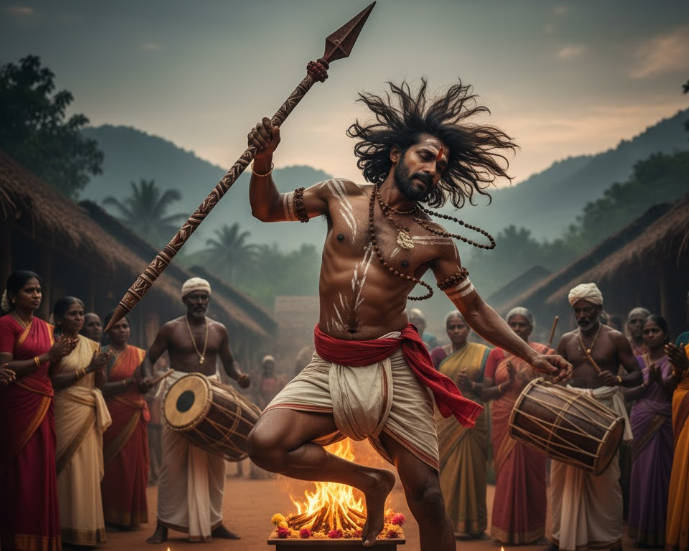
Within the framework of Sangam-era Akam poetry, a young girl’s emotional anguish or physical decline manifested through sorrow or emaciation is frequently interpreted by her family as a sign of divine possession by Lord Murugan. In response, her mother seeks to restore balance by commissioning a Veriyattam ritual, performed by a Velan priest devoted to Murugan.
Descriptions in Sangam Literature
Although Tolkappiyam lays the grammatical and thematic groundwork for understanding ‘Velan Veriyattam’, more vivid and detailed portrayals of the ritual appear in other Sangam-era texts. These include selections from the Ettuttokai (Eight Anthologies) and Pattuppattu (Ten Idylls), such as:
- Ainkurunuru: The ritual depicts a mother summoning a Velan to perform an exorcism for her daughter, whom she believes to be afflicted by divine possession. In reality, the girl’s suffering stems from a concealed romantic longing. Some poems subtly reveal her ironic or sarcastic remarks, exposing the Velan’s obliviousness to the true emotional cause behind her condition.
- Tirumurukāṟṟuppaṭai: In this text devoted wholly to Murugan, the Velan is portrayed as a prophetic figure endowed with supernatural abilities, revered as a living embodiment of the deity during the ritual. The ceremonial dance unfolds within a sanctified and ornately adorned space, accompanied by ritual offerings made in honor of Murugan.
- Other Texts: Veriyattam is referenced across a wide array of poems in classical Tamil anthologies such as Kuruntokai, Narrinai, and Akananuru. These verses vividly depict the ritual as a means to appease Murugan, featuring offerings of flowers, millet, and animal sacrifice, all set against a backdrop of intense drumming and resonant music.
Absence in Silapathigaram
Though Silapathikaram is a post-Sangam epic that draws upon earlier literary traditions, it does not offer the same intricate accounts of the ‘Velan Veriyattam’ ritual found in Sangam literature. Nonetheless, it references numerous temples and religious customs of the era, illustrating the enduring nature of devotional practices. The ritualistic elements portrayed in Sangam texts, including Veriyattam, reveal a cultural landscape where spiritual devotion and everyday life were profoundly interwoven.
Leave a Reply
You must be logged in to post a comment.